

Quick answer
Ice dams form in Hagerstown when heat from the house melts roof snow and the water freezes again at the cold roof edge, where it can back up under the shingles. The lasting fix is a sealed, insulated and vented attic plus ice and water shield at the eaves. A free roof inspection shows where your roof stands.
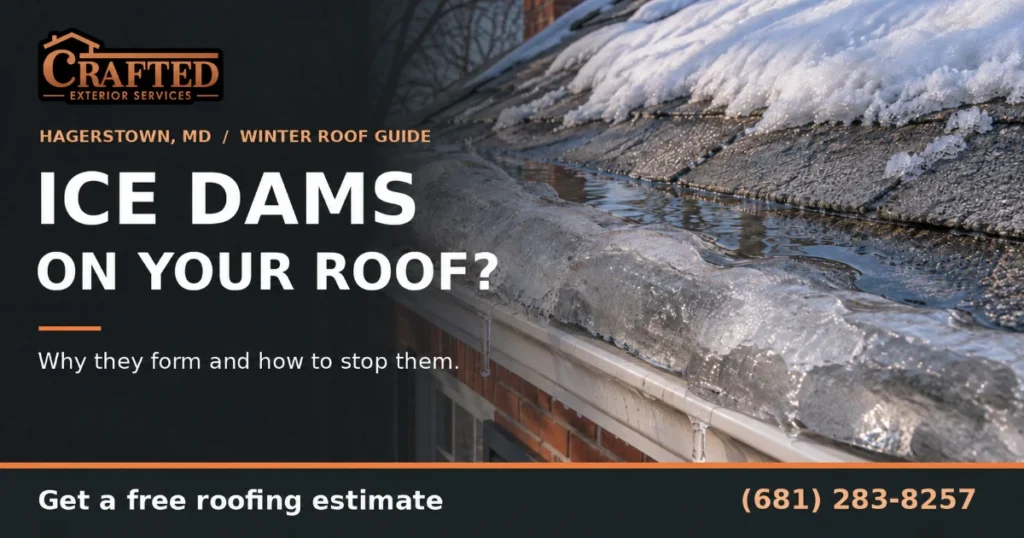
If you live in Hagerstown or anywhere in Washington County, you have probably seen a thick ridge of ice and a row of icicles hanging off a roof edge after a snowy week. That ridge is an ice dam. It looks harmless, but it is one of the main reasons roofs leak in the middle of winter, when nobody wants to deal with a wet ceiling.
What is an ice dam?
An ice dam is a ridge of ice that forms at the edge of a roof and stops melting snow from draining off. Water collects behind the ice. Shingles are built to shed water running downhill, not to hold back standing water, so that pooled water can work its way up under the shingles and into the attic, walls and ceilings. The University of Minnesota Extension explains it plainly: for an ice dam to form, there has to be snow on the roof, the upper part of the roof has to be above freezing, and the lower edge has to be below freezing.
Why ice dams form on Hagerstown roofs
Hagerstown sits in the Cumberland Valley, and our winters swing above and below freezing again and again. A few inches of snow, a sunny afternoon and a hard freeze that night is a perfect setup for an ice dam. The National Weather Service Baltimore/Washington office issues the snow and ice forecasts and winter storm warnings for Washington County, and it is worth checking before and after a storm.
The weather is only half of it. The other half is heat coming from your house. In most homes, the warm spot on the roof is caused by:
- Air leaks into the attic around ceiling lights, bath fans, attic hatches, plumbing stacks and chimneys.
- Thin or uneven attic insulation, so heat passes straight through the ceiling.
- Blocked or missing attic vents, so warm air sits under the roof deck instead of moving out.
- Heat sources in the attic like leaky ductwork or a bath fan that vents into the attic instead of outside.
Hagerstown has plenty of older homes, especially around downtown and the North End. Houses with finished upper rooms, sloped ceilings and knee walls, like a classic Cape Cod, have little room for insulation in those spaces, and the University of Minnesota Extension lists knee wall spaces among the attic heat sources behind ice dams. On a brick Cape Cod we re-roofed in Hagerstown, keeping the soffit vents open was part of the plan for exactly this reason.
Signs you have an ice dam (or had one)
- A thick band of ice along the roof edge, often with large icicles hanging from the gutters.
- Water stains or damp spots on ceilings or upper walls near an outside wall.
- Wet or matted insulation in the attic near the eaves.
- Peeling paint or water marks on the soffit and fascia.
- Gutters pulling away from the house under the weight of ice.
Moisture from an ice dam can lead to mold if it sits. The U.S. Environmental Protection Agency advises drying wet materials within 24 to 48 hours to prevent mold growth.
What to do if you see an ice dam right now
- Stay off the roof. Icy shingles and ladders are dangerous, and chipping at the ice with a hammer or shovel can crack shingles and gutters.
- Pull snow off the lower edge from the ground. A long-handled roof rake lets you clear the bottom few feet of the roof so less snow melts and refreezes there. The National Weather Service recommends roof rakes for this. Pull gently, because the University of Minnesota Extension warns that rakes can damage roofing.
- Keep gutters and downspouts open. Clear snow and ice from the downspout outlets so meltwater has somewhere to go.
- Check the attic and ceilings. Look for wet insulation, dripping nails or new stains, and catch any drips with buckets and towels.
- Take photos. Photograph the ice and any inside damage before cleanup in case you file an insurance claim.
- Call for an inspection. If water got inside, the roof, decking and attic should be checked so the real cause gets fixed, not just the stain. Crafted Exterior Services offers roof repair in Hagerstown and emergency roof repair for active leaks.
How to stop ice dams for good
Getting rid of one ice dam does not stop the next one. The lasting fix is keeping the roof deck cold and the roof edge protected.
Seal and insulate the attic
Air sealing comes first. The University of Minnesota Extension calls air leaking from the house into the attic the main way heat reaches the roof in many homes. Once the leaks are sealed, adding insulation cuts heat loss through the ceiling. The National Weather Service recommends at least R-30 attic insulation, with R-38 preferred in colder climates. An insulation contractor can handle that part.
Keep the attic vented
Good airflow from the soffit vents along the underside of the roof and out through the ridge or roof vents keeps attic air cold. Insulation pushed against the soffit vents blocks that airflow. Every Crafted Exterior Services inspection looks at the attic ventilation along with the shingles, flashing and decking.
Protect the eaves when the roof is replaced
Ice and water shield is a waterproof membrane installed under the shingles. Maryland’s adopted building codes call for this protection to reach at least 24 inches inside the exterior wall line at the eaves. On every roof replacement in Hagerstown, Crafted Exterior Services tears the old roof off to the decking and installs ice and water shield at the vulnerable areas, with synthetic underlayment over the rest of the deck. If you are planning a new roof, it is also a good time to ask about metal roofing, which sheds snow and ice and can be paired with a snow retention system so snow does not slide off the edge in one mass.
Keep the gutters working
Clogged gutters hold water and ice right at the roof edge, which makes ice dams worse. Seamless gutters that are sized and pitched correctly, and cleaned after the leaves come down in the fall, help meltwater drain away.
Frequently asked questions
What causes ice dams on a roof?
Ice dams need snow on the roof, a roof surface that is warmer than 32°F up high and colder than 32°F at the edge. Most of that heat comes from the house: warm air leaking through ceiling lights, attic hatches and ducts, or thin attic insulation. Snow melts on the warm part, runs down and freezes at the cold eave.
How do you fix an ice dam on a roof?
Stay off the roof and off icy ladders. Pull snow off the lower few feet of the roof with a long-handled roof rake from the ground, and keep gutters and downspouts clear. If water is already coming inside, call a roofer to check the damage. The lasting fix is stopping attic heat loss and making sure the eaves have ice and water shield under the shingles.
Does homeowners insurance cover ice dam damage?
It depends on your policy. Read the water damage and roof sections of your policy or ask your agent, and take photos of the ice and any interior damage before cleanup. The Maryland Insurance Administration answers consumer questions about homeowners insurance and handles complaints.
What can I put on my roof to stop ice dams?
The best protection sits under and inside the roof, not on top of it. Ice and water shield along the eaves stops water that backs up from reaching the decking, and a sealed, well-insulated, vented attic keeps the roof deck cold so snow does not melt and refreeze. Clear gutters help melting snow drain off.
Do I need a permit to repair ice dam damage in Hagerstown?
Inside Hagerstown city limits, a permit is needed when more than 20% of the roof sheathing is replaced, when the roofing material changes, or when a new roof goes over an old one. Small repairs below those limits usually do not need one. Crafted Exterior Services tells you during the inspection if your repair needs a permit.
Get your roof checked before the next snow
If you had ice dams last winter, or you see stains near the edge of your ceiling, the cause is still there. Crafted Exterior Services starts every job with a free roof inspection and written estimate that covers the roof, decking, flashing, ventilation and drainage. Learn more about our roofing services in Hagerstown and our winter and storm damage repairs, or contact us to schedule your free inspection.
Crafted Exterior Services
684 Pennsylvania Ave 2A, Hagerstown, MD 21740
(301) 462-3229
Repairs inside Hagerstown city limits may need a permit from the City of Hagerstown permits office. For questions about your homeowners coverage, the Maryland Insurance Administration can help.