Residential Flat Roofing
Get In Touch Today
Crafted Exterior Services
Address: 85 Lynnhaven Dr Unit E, Martinsburg, WV 25404
Phone Number: (681) 283-8257
Email: craftedservices@gmail.com
Business Hours:
Monday: 8:00 – 5:00 PM
Tuesday: 8:00 – 5:00 PM
Wednesday: 8:00 – 5:00 PM
Thursday: 8:00 – 5:00 PM
Friday: 8:00 – 5:00 PM
Saturday: Closed
Sunday: Closed
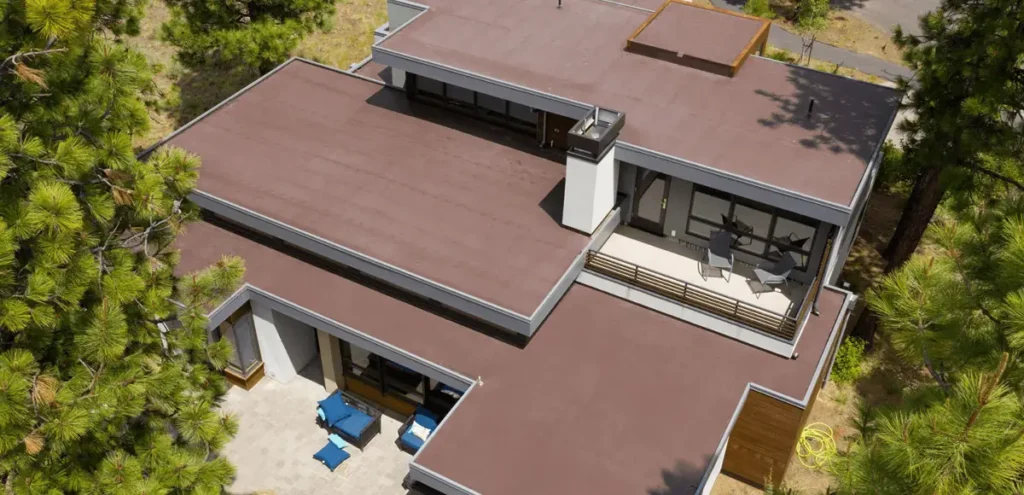
A residential flat roofing system relies on a continuous waterproof membrane and correct drainage to move water off the surface rather than shed it by gravity alone. Built right, it protects a home for decades. Built poorly, it lets water find every weak seam. Low-slope assemblies are standard on additions, sunrooms, and porch covers even on otherwise pitched homes, and light-colored membranes can trim summer cooling loads. The U.S. Department of Energy reports that reflective cool roof surfaces can stay significantly cooler than dark roofs under full sun.
Crafted Exterior Services installs, repairs, and replaces flat and low-slope roofs for homeowners across Martinsburg and the Eastern Panhandle, matching the right membrane system to your home, your budget, and West Virginia’s freeze-thaw climate. Our crews follow workmanship standards published by the National Roofing Contractors Association, with tapered insulation for positive drainage, fully adhered membranes, and heat-welded or seam-taped laps built to handle the temperature swings common to the Eastern Panhandle.
Is a Flat Roof Right for Your Home?
A “flat” roof is almost never flat. Building codes call for a minimum slope of about 1/4 inch per foot, or a 2 percent pitch, so water drains toward scuppers, internal drains, or gutters instead of pooling. Any roof with a pitch below 3:12 counts as low-slope and needs a membrane system rather than shingles, because shingles rely on gravity and steep angles to shed water and will leak on a shallow deck.
Flat roofs are less common on full houses in our area for a few reasons. Snow and ice sit longer on a low-slope surface than they slide off a steep one, so the deck and membrane must be rated for the region’s snow load. Standing water, called ponding, is the other concern: water that remains on a membrane more than 48 hours after rain accelerates wear and hints at a drainage problem. Both issues are design problems with design solutions, which is why professional installation matters more on a flat roof than on almost any other roof type. A pre-project roof inspection confirms the deck can carry the load and drain the way it should.
Brands We Work With


Benefits of a Residential Flat Roof
Flat roofs earn their place on modern homes and additions for reasons that go beyond looks. Each benefit below reflects how these systems perform on real Eastern Panhandle homes.
- Usable rooftop space: A flat roof turns an unused surface into a deck, a garden, a solar array platform, or a mechanical pad for HVAC equipment. That is space a pitched roof cannot provide, and it adds function without expanding a home’s footprint.
- Lower material and labor cost per square: With no steep angles to navigate, crews work faster and safer, and single-ply membranes cover large areas with fewer components. The savings show up on additions and detached structures where a flat deck is the practical choice.
- Clean, contemporary lines: A flat profile suits modern and mid-century architecture and keeps sightlines low, which many homeowners prefer for garages, carports, and rear additions.
- Energy performance: Reflective white membranes such as TPO and PVC bounce back a large share of solar heat, easing cooling costs in summer. Paired with the right insulation, a low-slope assembly holds a stable indoor temperature through both seasons.
- Straightforward equipment access: Servicing rooftop HVAC, skylights, and drains is safer on a walkable flat surface than on a steep pitch, which lowers long-term maintenance risk.
Drawbacks, Myths, and Insurance Considerations
Flat roofs carry a reputation for leaks that is half history and half misunderstanding. Older tar-and-gravel roofs did fail at seams, but modern welded and adhered membranes have closed most of that gap. Still, homeowners should weigh a few honest trade-offs before committing.
Drainage is the first. A flat roof with poor slope or clogged drains will hold water, and standing water is the leading cause of premature membrane failure. Routine maintenance and clear drains solve this, but the roof demands attention a steep roof does not. Wind uplift is the second: on an exposed low-slope roof, the membrane must be anchored to resist lifting, which is why fastening patterns and edge detailing are not places to cut corners.
Insurance is a frequent question. Some carriers view flat roofs as higher risk because ponding and aging membranes raise the odds of a claim, and a few limit coverage or charge more for older systems. Keeping documentation of your membrane type, installation date, and inspection history helps at renewal time. If a storm does hit, our storm damage repair team can document conditions for a claim, and for active leaks our emergency roof repair crew responds fast to limit interior damage.
One rule worth knowing is the 25 percent rule. Under the International Existing Building Code language adopted across most of the country, if you repair or recover more than 25 percent of a roof section within any 12-month window, the entire roof area must be brought up to current code rather than patched piecemeal. On an aging flat roof, that threshold often tips the math from repeated patching toward a full roof replacement that resets the clock and the warranty.
Flat Roofing Systems We Install in Martinsburg & Across West Virginia
There is no single best flat roof. The right membrane depends on the size of the deck, sun exposure, foot traffic, budget, and how long you plan to own the home. We install and service the full range of residential low-slope systems.
- EPDM rubber: A single-ply synthetic rubber membrane, EPDM has protected low-slope roofs for more than 40 years. It comes in 45 to 60 mil thicknesses, resists UV and ozone, and stands up to freeze-thaw cycles, which makes it a strong fit for our climate. Seams are joined with tape or adhesive, and repairs are simple, so EPDM often wins on cost and serviceability. Learn more about EPDM roofing.
- TPO membrane: Thermoplastic polyolefin is a single-ply membrane with heat-welded seams that form a monolithic, watertight surface. Its reflective white finish, available in 45 to 80 mil, bounces solar heat and suits energy-minded homeowners. TPO has become one of the fastest-growing low-slope materials in the country. See our full TPO roofing page for details.
- PVC membrane: Also heat-welded, PVC offers the strongest seams of the single-ply family and resists grease, chemicals, and standing water better than most alternatives. It is the premium single-ply choice for demanding conditions.
- Modified bitumen: This asphalt-based membrane is reinforced with SBS or APP polymers and applied in layers by torch, hot mop, or self-adhesive. Its multi-ply build gives redundant waterproofing that suits small residential decks and porches.
- Built-up roofing (BUR): The classic tar-and-gravel system layers alternating bitumen and reinforcing fabric, then finishes with a gravel surface that shields the membrane and adds fire resistance. It has protected buildings for over a century and remains a durable, walkable option.
- Roof coatings and restoration: Seamless silicone and acrylic coatings can extend the life of a sound but aging membrane at a fraction of replacement cost. These restoration systems are a proven approach we apply on sound decks that do not yet need a tear-off.
- Low-slope metal: For homeowners after the longest service life, a standing-seam metal roofing system engineered for low slope pairs a long lifespan with a modern look.
Residential Flat Roofing Material Comparison
The table below compares the residential flat roofing systems we install so you can weigh lifespan, ideal use, and the strength each brings to the decision.
Membrane System | Typical Lifespan | Best Suited For | Key Advantage |
EPDM rubber | 25 to 30 years | Budget builds and large decks | Proven durability, easy repair |
TPO | 20 to 30 years | Energy-focused homes | Reflective, heat-welded seams |
PVC | 20 to 30 years | Chemical or grease exposure | Strongest single-ply seams |
Modified bitumen | 15 to 20 years | Small decks and porches | Redundant multi-layer build |
Built-up (BUR) | 15 to 30 years | Walkable, high-traffic roofs | Time-tested, fire resistant |
Low-slope metal | 40 to 70 years | Long-term ownership | Longest service life |
Signs Your Flat Roof Needs Attention in Martinsburg & Across West Virginia
Flat roof problems rarely announce themselves with an obvious hole. Most membrane failures develop gradually, which is why knowing what to look for helps Martinsburg homeowners catch issues before water reaches the decking and framing below.
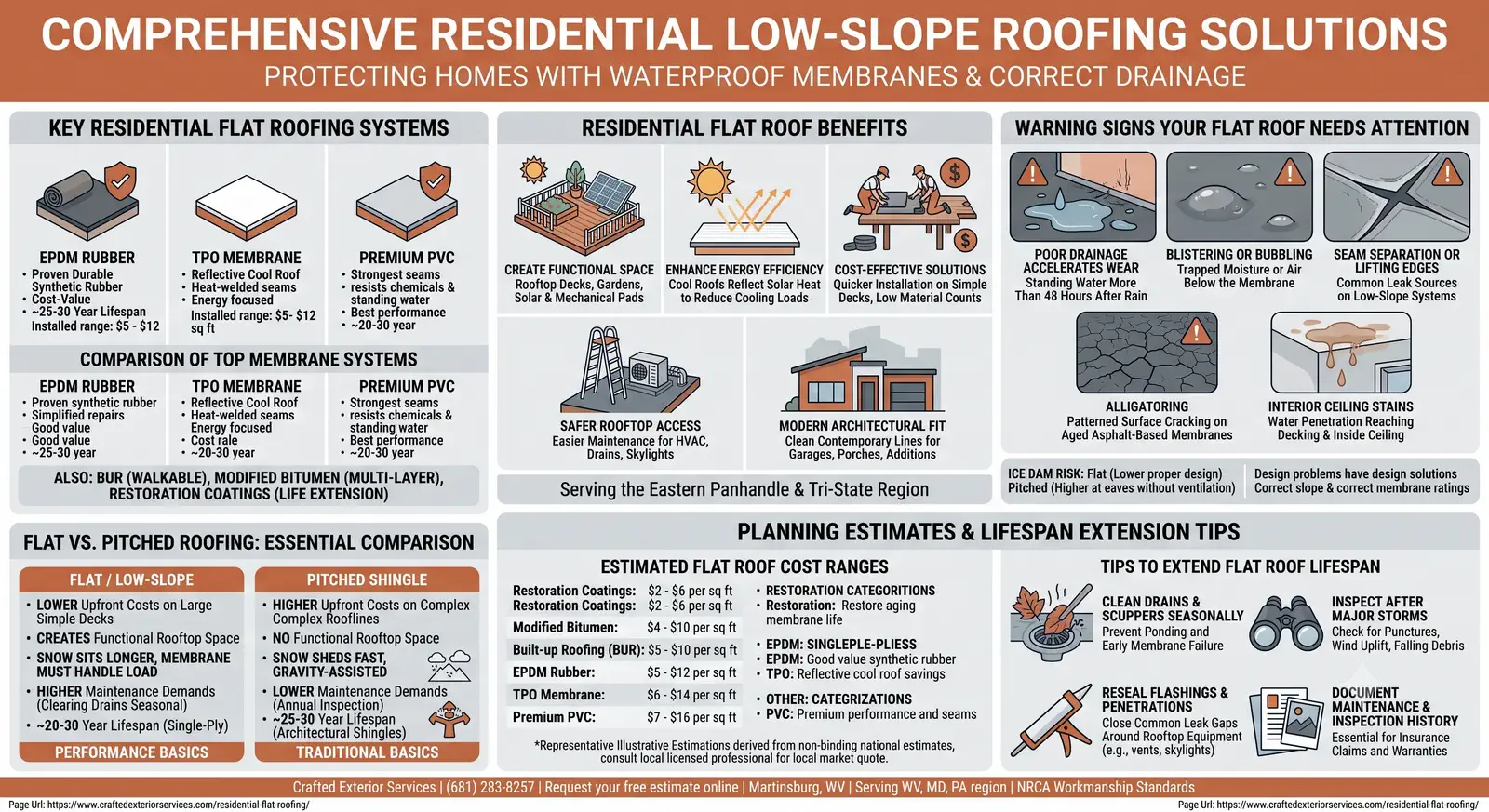
- Blistering or bubbling on the membrane surface indicates trapped moisture or air beneath the membrane, a sign the adhesion has failed and the system is vulnerable to further separation.
- Alligatoring or surface cracking appears on aged asphalt-based membranes that have dried out and lost flexibility, leaving the surface patterned like reptile skin and no longer watertight.
- Standing water more than 48 hours after rain signals a drainage or slope problem that is accelerating membrane wear with every rainfall.
- Seam separation or lifting membrane edges at walls, parapets, or penetrations are the most common active leak sources on flat roofs across Berkeley County homes.
- Interior ceiling stains appearing after rain on rooms below a flat section indicate water has already penetrated the membrane and is working through the decking.
- Granule loss or exposed fabric on modified bitumen sections signals the surface layer has worn through and UV damage to the membrane itself has begun.
- Sagging or soft spots in the deck when walking a flat roof section point to long-term moisture intrusion that has begun rotting the structural decking beneath the membrane.
If you notice any of these signs on your Martinsburg property, a professional roof inspection is the right next step before the damage progresses further.
Flat Roof vs Pitched Roof for Eastern Panhandle Homes
Martinsburg homeowners adding a garage, sunroom, or rear addition often weigh whether to continue the home’s pitched roofline or go with a flat assembly. Both work in West Virginia’s climate when built correctly. The comparison below covers the factors that matter most for Berkeley County properties.
Feature | Flat / Low-Slope Roof | Pitched Shingle Roof |
Upfront cost per square | Lower on large, simple decks | Higher on complex rooflines |
Snow shedding | Slower, requires load-rated deck | Faster, gravity-assisted |
Ice dam risk | Lower with proper drainage design | Higher at eaves without ventilation |
Maintenance demands | Higher, twice-yearly drain clearing | Lower, annual inspection sufficient |
Lifespan | 20 to 30 years for single-ply | 25 to 30 years for architectural shingles |
Usable rooftop space | Yes, accessible deck possible | No |
Architectural fit | Modern, addition, garage, porch | Traditional homes, steep rooflines |
Storm damage profile | Wind uplift risk at edges | Hail and granule loss risk |
For most full-house applications in Berkeley County, a pitched roof is the practical default. For additions, porch covers, garages, and modern architectural styles, a flat assembly is often the cleaner and more cost-effective choice when drainage and membrane selection are handled correctly.
What a Residential Flat Roof Costs in Martinsburg & Across West Virginia
Flat roof pricing depends on square footage, membrane type, insulation, tear-off of the old roof, and the complexity of penetrations like drains, vents, and skylights. As a working range, most residential membrane systems fall between 4 and 16 dollars per square foot installed, with coatings coming in lower because they restore rather than replace. A small porch or garage roof may run a few thousand dollars, while a full flat-roof addition can reach the mid five figures.
The intro figures below are planning estimates for the Martinsburg market. Your written quote after an on-site measurement is the number that counts, and we provide that at no cost.
Estimated Flat Roof Cost Ranges by System
Roofing System | Installed Cost per Square Foot | Notes |
Roof coating or restoration | $2 to $6 | Extends life of a sound membrane |
Modified bitumen | $4 to $10 | Cost-effective for small decks |
Built-up (BUR) | $5 to $10 | Labor-intensive, long track record |
EPDM rubber | $5 to $12 | Strong value for large surfaces |
TPO | $6 to $14 | Reflective, energy savings offset cost |
PVC | $7 to $16 | Premium performance and seams |
For a clear read on whether a targeted fix or a full system makes more sense on your budget, start with a roof leak repair assessment or a broader roof repair evaluation before committing to replacement.
Why Choose Crafted Exterior Services
- Local Martinsburg Base: We operate from a real office at 85 Lynnhaven Dr Unit E, Martinsburg, WV, with crews who know Berkeley County’s permit requirements, local building codes, and the specific freeze-thaw conditions that flat roofing membranes must perform across the Eastern Panhandle.
- Correct Drainage Design: Every flat roof we install includes proper slope correction and tapered insulation to eliminate standing water, the single most common cause of premature membrane failure on residential flat sections.
- Fully Adhered Membrane Systems: We install TPO and EPDM membranes using fully adhered methods that bond the membrane directly to the deck, eliminating wind uplift risk and the billowing that leads to seam failure over time.
- Sealed Penetrations and Transitions: Pipe boots, drains, parapet walls, and roof-to-wall transitions are the highest-risk points on any flat roof, and we seal every one to manufacturer specifications before the job is considered complete.
- Licensed and Fully Insured: Crafted Exterior Services carries all licenses required by the West Virginia Division of Labor and maintains full liability and workers compensation coverage on every job site.
- Written Warranties on Every Install: Every residential flat roofing project includes both the manufacturer material warranty and our own written workmanship warranty, handed over at the final walk-through.
- Honest Repair vs Replace Guidance: If a targeted membrane repair is the right call for your flat section, we say so. We do not push replacements when a repair solves the problem.
Residential Flat Roof Lifespan and How to Extend It
A flat roof’s lifespan comes down to the membrane, the quality of installation, and how well it is maintained. EPDM and single-ply membranes deliver 20 to 30 years, built-up systems 15 to 30, and low-slope metal can run 40 years or more. Maintenance is what separates a roof that reaches the top of that range from one that fails early. These habits keep a residential flat roof watertight:
- Clear drains and scuppers each season: Leaves and debris block drainage and cause ponding, which is the leading driver of early membrane failure. A twice-a-year cleaning keeps water moving off the roof.
- Inspect after major storms: Wind, hail, and falling branches can puncture or lift a membrane. A quick look after severe weather catches damage before it spreads into the deck.
- Reseal flashings and penetrations: The edges around vents, skylights, and walls are where most leaks begin. Refreshing sealant and flashing on a set schedule closes those gaps.
- Address ponding fast: Water sitting more than 48 hours signals a slope or drain problem that will only worsen. Correcting it early avoids membrane breakdown and structural moisture.
- Schedule professional checks: An annual inspection by a roofer catches seam separation, blistering, and wear that an untrained eye misses. Pair maintenance with our residential roofing service to keep the whole roof on track.
Our Residential Flat Roofing Process
Every flat roof project we take on follows the same disciplined sequence, so nothing gets missed between the first call and the final walkthrough.
- Inspection and measurement: We assess the deck, current membrane, slope, and drainage, then measure for an accurate quote.
- System recommendation: We match a membrane to your home, climate, and budget, and explain the trade-offs so you decide with full information.
- Tear-off or recover: Where code and condition allow, we recover an existing roof; otherwise we remove the old system down to a sound deck.
- Insulation and drainage: We add or adjust tapered insulation to build a positive slope toward drains, eliminating flat spots that pond.
- Membrane installation: We install and weld or adhere the chosen membrane, detailing every edge, penetration, and seam to manufacturer spec.
- Final inspection and cleanup: We flood-test or water-test as needed, walk the finished roof with you, and leave the site clean.
What Our Clients Are Saying
Proudly Serving Martinsburg and the Tri-State Region With Expert Residential Flat Roofing Services
Crafted Exterior Services installs, repairs, and replaces residential flat and low-slope roofing systems for homeowners throughout Martinsburg, the Eastern Panhandle of West Virginia, and communities across Maryland and Pennsylvania. Whether your home has a flat porch cover, a low-slope addition, or a full architectural flat roof section, our licensed and insured crew delivers the correct membrane system, proper drainage design, and sealed penetrations that keep flat roofs performing through every season the tri-state climate produces.
We are proud to provide residential flat roofing services in Martinsburg, WV, Hagerstown, MD, Charlestown, WV, Inwood, WV, Hedgesville, WV, Williamsport, MD, and Chambersburg, PA. For a full view of our coverage, visit our service area page.
Schedule Your Free Residential Flat Roofing Estimate in Martinsburg & Across West Virginia Today
A flat or low-slope roof section that is leaking, aging, or holding standing water will not improve on its own. The longer membrane damage goes unaddressed, the more water works its way into your decking, insulation, and interior framing. Crafted Exterior Services serves homeowners across Martinsburg, Berkeley County, and the broader tri-state region with honest flat roofing assessments, clear written estimates, and membrane installations built to hold through West Virginia’s full range of seasonal weather.
Call (681) 283-8257 or request your free estimate online and our local team will get back to you promptly.
Get in Touch Today
Crafted Exterior Services
Address: 85 Lynnhaven Dr Unit E, Martinsburg, WV 25404
Phone Number: (681) 283-8257
Email: craftedservices@gmail.com
Business Hours:
Monday: 8:00 – 5:00 PM
Tuesday: 8:00 – 5:00 PM
Wednesday: 8:00 – 5:00 PM
Thursday: 8:00 – 5:00 PM
Friday: 8:00 – 5:00 PM
Saturday: Closed
Sunday: Closed
Frequently Asked Questions
How does West Virginia's freeze-thaw climate affect a residential flat roof?
Repeated freeze-thaw cycles stress membrane seams, flashing transitions, and penetration seals. Water pooling on an improperly drained flat section can freeze, expand, and force its way under membrane laps. Every flat roof we install in Martinsburg includes positive drainage slope and fully adhered membranes to prevent exactly that.
When should a West Virginia homeowner repair versus replace a flat roof section?
If the membrane is within the first half of its service life and damage is limited to a single seam or small puncture, a repair is usually the right call. Widespread blistering, multiple leak sources, or a membrane nearing the end of its lifespan points toward replacement. We provide a free inspection and written assessment so you know which option actually fits your situation.
What are the downsides of a flat roof?
The main trade-offs are drainage and maintenance. A low-slope roof sheds water slower than a pitched one, so it needs clear drains and a membrane in good repair to avoid ponding. It also demands routine attention. With modern welded or adhered membranes and a set maintenance schedule, most of these concerns fade into manageable upkeep.
Is it okay to have a flat roof on a house in Martinsburg & across West Virginia?
Yes. Flat and low-slope roofs are a sound choice for additions, garages, and porches across Berkeley County as long as the design includes proper slope, drainage, and a membrane suited to West Virginia’s freeze-thaw climate.
How much does a residential flat roof cost in Martinsburg & across West Virginia?
Most residential flat roof systems run between 4 and 16 dollars per square foot installed, depending on membrane type, insulation, tear-off, and roof complexity. Coatings cost less because they restore an existing roof. A written on-site estimate is the only way to get a firm number, and we provide one at no charge.
Why do insurance companies not like flat roofs on homes in West Virginia?
Some carriers see flat roofs as higher risk due to ponding and aging membranes. Newer welded membranes and documented inspection records ease that concern. Martinsburg homeowners who track their membrane type, install date, and maintenance history are in a stronger position at renewal.
What is the average lifespan of a residential flat roof in West Virginia's climate?
Single-ply membranes like EPDM and TPO last 20 to 30 years. Built-up and modified bitumen roofs run 15 to 30 years. West Virginia’s freeze-thaw cycling stresses seams and flashings, so quality installation and steady maintenance are what push any system toward the top of its range.
What is the 25 percent rule for roofing?
The 25 percent rule comes from the International Existing Building Code. If more than 25 percent of a roof section is repaired or recovered within a 12-month period, the whole roof area must be brought up to current code. On an older flat roof, hitting that threshold often makes a full replacement the smarter path than repeated patching.
Do flat roofs leak more than pitched roofs in Martinsburg & across West Virginia?
Not by design. Most flat roof leaks on Eastern Panhandle homes trace back to poor drainage, aging flashing sealant, or damage left unrepaired through a wet season, all of which routine inspections catch before they become active leaks.
Schedule Your Free Roofing Estimate Today
A damaged or aging roof does not fix itself, and the longer a problem goes unaddressed, the more it costs to correct. Whether you need a quick repair or a full roof replacement, Crafted Exterior Services makes it simple for homeowners and commercial property owners to get clear answers fast. Contact us to schedule a free estimate and find out exactly what your roof needs, what it will cost, and how quickly we can get the work done.
Call us today at (681) 283-8257 or schedule your free roof estimate online.