When Your Commercial Roof Fails, Every Minute Costs You Money
Hiring the right commercial roof repair company is one of the most important decisions a business owner can make — and one of the most overlooked until something goes wrong.
Here’s what to look for at a glance:
| What to Look For | Why It Matters |
|---|---|
| Low safety EMR (below 1.0) | Reduces your liability risk on-site |
| Licensed & insured | Protects you from cost overruns and legal exposure |
| Manufacturer certifications | Keeps your roof warranty valid |
| 24/7 emergency response | Stops damage from spreading fast |
| Written documentation | Supports insurance claims and future maintenance |
A leaking commercial roof doesn’t just damage the building — it threatens your inventory, equipment, employees, and daily operations. Water intrusion spreads fast, and what starts as a small membrane failure or clogged drain can escalate into a five-figure repair bill within days.
That’s why working with a trusted commercial roofing partner from the start — not after the ceiling tiles are soaking — is the smartest move a property owner can make.
This guide walks you through everything you need to know: how to spot damage early, how to choose a qualified contractor, and how to protect your roof (and your budget) for the long haul.
Common Types of Commercial Roof Damage and Diagnostic Methods
Commercial roofs are complex engineering systems designed to withstand harsh weather, ultraviolet radiation, and extreme temperature fluctuations. However, they are highly susceptible to specific failure modes that differ fundamentally from residential properties. Understanding these common types of commercial roof damage allows facility managers to catch problems before they compromise the building’s structural integrity.
Common Types of Commercial Roof Damage
- Ponding Water & Drainage Failures: Standing water is the single most destructive force on a flat or low-slope commercial roof. If water remains on the roof surface for more than 48 hours after rain, it is classified as ponding water. This excess weight stresses the structural deck, accelerates membrane UV degradation, and eventually destroys the adhesive seams.
- Membrane Punctures, Splits, and Blisters: Single-ply membranes like TPO, EPDM, and PVC can be punctured by dropped tools during HVAC servicing, flying storm debris, or heavy foot traffic. Blistering occurs when moisture becomes trapped beneath the membrane layers; as the sun heats the roof, this moisture expands into air pockets that stretch and weaken the material.
- Flashing & Penetration Failures: The vast majority of active commercial leaks originate at the flashings. Flashings are the metal or membrane transitions around roof penetrations, including HVAC units, skylights, vents, and parapet walls. Over time, thermal expansion causes these joints to pull apart, creating direct paths for water intrusion.
- Thermal Expansion & Fastener Back-Out: Metal roofs and single-ply membranes expand and contract daily. This continuous movement can loosen mechanical fasteners, causing them to back out of the deck. Backed-out fasteners can puncture the waterproofing membrane from underneath, leading to hidden leaks.
Advanced Diagnostic Methods Used by Professionals
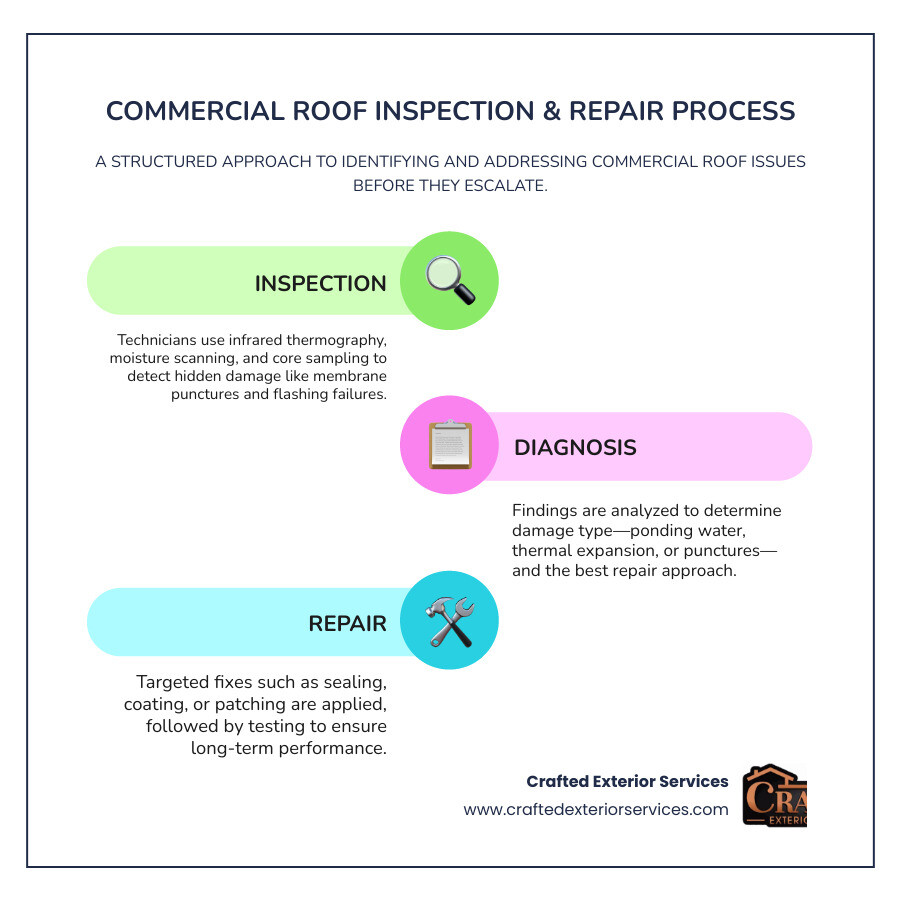
To accurately identify hidden issues, an experienced commercial roof repair company uses advanced, non-destructive diagnostic tools rather than relying on visual inspection alone.
- Infrared Thermography (IR Scanning): During the day, wet roof insulation absorbs and retains heat longer than dry insulation. After sunset, a technician equipped with an infrared thermal camera scans the roof. The wet areas stand out as hot spots on the thermal image, allowing the team to pinpoint exact areas of trapped moisture without tearing up the roof.
- Core Sampling: This physical diagnostic involves cutting a small, cylindrical plug through the roofing membrane down to the deck. Core sampling allows technicians to inspect the underlying insulation layers, verify the exact deck material, and check for hidden rot or deck deterioration. The sample hole is immediately patched and sealed to restore waterproofing.
- Electronic Moisture Detection: Using high-frequency electrical capacitance, this method measures the electrical resistance of the roofing assembly. Because water conducts electricity far better than dry insulation, this tool maps out precise moisture boundaries with exceptional accuracy.
Addressing these issues early is critical. If you suspect your property has hidden moisture or active leaks, scheduling professional commercial roof leak repair services can prevent costly structural rot. For comprehensive industry guidelines on commercial diagnostics, property owners can consult the National Roofing Contractors Association (NRCA), which outlines the standards for professional moisture evaluations. Additionally, you can review field-tested repair methodologies through Commercial Roof Repair Services | Nations Roof .
Commercial Roof Repair vs. Restoration vs. Full Replacement
When faced with a failing commercial roof, facility managers must decide whether to repair localized damage, restore the entire surface, or invest in a full replacement. Making the wrong choice can lead to wasted capital or premature system failure.
| Metric | Commercial Roof Repair | Commercial Roof Restoration | Full Roof Replacement |
|---|---|---|---|
| Average Cost | Low (Typically billed per repair area) | Moderate (30% to 50% less than replacement) | High (Full capital expenditure) |
| Expected Lifespan | Temporary to short-term extension | 10 to 15 additional years | 20 to 30 years |
| Tax Treatment | Operating Expense (OpEx) – Fully deductible | Operating Expense (OpEx) – Often fully deductible | Capital Expenditure (CapEx) – Amortized over decades |
| Business Disruption | Minimal to none | Very low (No structural tear-off) | Moderate to high |
Key Restoration Materials and Methods
Commercial roof restoration is an excellent intermediate solution for roofs that are aging but structurally sound. It involves thoroughly cleaning the roof, repairing minor defects, and applying a high-performance coating system across the entire surface.
- Polyurethane Foam (PUF): Polyurethane foam has been widely used on commercial and industrial buildings for more than 25 years. It is sprayed on as a liquid, expanding into a seamless, solid foam barrier that provides both exceptional waterproofing and high thermal insulation (R-value).
- High-Solids Silicone Coatings: These elastomeric coatings form a highly reflective, monolithic membrane over the existing roof. Reflective coatings significantly reduce the building’s heat load, lowering energy cooling demands and protecting the underlying membrane from UV damage.
If you are unsure which path is right for your property, read our comprehensive guide on how to tell when it’s time to fix or replace your roof. For a deeper understanding of single-ply and multi-ply commercial options, you can explore the official GAF Commercial Roofing Systems page. You can also view real-world restoration applications by reading about Commercial Roof Restoration Services .
Key Criteria for Selecting a Commercial Roof Repair Company
Selecting a commercial roofing contractor requires a higher level of scrutiny than choosing a residential roofer. Commercial roofing involves larger scales, complex drainage challenges, and strict building codes.
Essential Credentials to Verify
- Safety EMR (Experience Modification Rate): EMR is a metric used by insurance companies to gauge a contractor’s safety record and claim history. The industry benchmark is 1.0. A premium, safety-focused commercial roof repair company will often maintain a safety EMR of 0.65 or lower, indicating an exemplary safety record with fewer on-site accidents.
- Comprehensive Liability Insurance: Ensure the contractor carries commercial general liability insurance (typically a minimum of $2 million to $5 million) and full workers’ compensation coverage to protect your business from third-party liability.
- Local Licensing & Regional Reputation: The contractor must be fully licensed to perform commercial work in your specific municipality. For properties in Martinsburg, WV, Bunker Hill, WV, and Hagerstown, MD, working with a local contractor who understands regional weather patterns is crucial.
- Repeat Clientele: A high rate of returning customers is the strongest indicator of quality. Top-tier commercial roofers often report that repeat business accounts for 95% or more of their total operations.
To ensure your property is protected by a licensed, local specialist, explore our full suite of professional commercial roofing services. You can also verify local manufacturer credentials through the GAF Certified Commercial Contractor Directory or search for qualified regional installers in Maryland using the resource for the Best Roofers in Hagerstown, MD | GAF Roofing Contractors .
Why You Need a Certified Commercial Roof Repair Company
Using an uncertified contractor to repair your roof can instantly void your manufacturer’s warranty. Commercial roofs are typically backed by valuable manufacturer warranties, including No Dollar Limit (NDL) warranties, which cover 100% of the labor and material costs for covered repairs over a 10-to-25-year period.
To keep these warranties intact, repairs must be completed by a manufacturer-certified contractor using compatible, approved materials and techniques. For example, patching a TPO roof requires specific hot-air welding equipment and matching membrane thicknesses. Using improper adhesives or residential-grade sealants will fail quickly and void your warranty coverage.
For industry standards on single-ply membrane installation and material compatibility, refer to the Single Ply Roofing Industry (SPRI). If you are managing commercial assets across West Virginia, Ohio, or Kentucky, you can also cross-reference certified regional standards by checking out the Roofing Contractor in WV, OH & KY | Design Roofing — 40+ Years platform.
How a Commercial Roof Repair Company Minimizes Business Disruption
A professional commercial roofer knows that your business cannot grind to a halt during construction. They minimize operational downtime through structured project management:
- Predictive & Off-Peak Scheduling: Performing noisy or disruptive work, such as crane operations or heavy tear-offs, early in the morning, late in the evening, or over weekends.
- Strategic Safety Staging: Erecting safety barriers, pedestrian canopies, and debris chutes to keep active building entrances and parking areas completely safe and clear.
- Odor & Vapor Mitigation: Using low-VOC (volatile organic compound) adhesives and cold-applied systems to prevent chemical fumes from entering the building’s HVAC intake vents.
When an unexpected leak threatens your interior operations, our fast-response emergency commercial roof repair team is ready to deploy. You can also learn more about how national commercial firms handle large-scale logistics by visiting National Commercial Roofing | Repair, Restore, Replace | Simon Roofing .
Managing Emergency Commercial Roof Repairs and Storm Damage
Severe weather events — such as high winds, heavy snow loads, and hail — can cause sudden, catastrophic damage to commercial roofs. When a crisis strikes, having an established emergency plan is vital to protecting your inventory, electronic equipment, and structural assets.
Critical Emergency Response Protocols
- Immediate 24/7 Dispatch: A reliable roofing partner maintains a dedicated emergency dispatch line. Crews should arrive on-site within hours of the call to assess the situation.
- Temporary Mitigation & Leak Stoppage: The primary goal of an emergency visit is to stop active water infiltration. This is accomplished using heavy-duty tarps, temporary membrane patches, or water-reactive sealants that cure even in wet conditions.
- Structural Stabilization: If heavy snow or ponding water has compromised the roof deck, structural shores and supports are installed to prevent a localized collapse.
- Comprehensive Insurance Documentation: Technicians should document all damage using high-resolution photography and detailed written reports. This clear evidence is crucial for filing successful commercial property insurance claims.
If your property has recently suffered wind or hail damage, our specialists can guide you through the recovery process with our certified commercial storm damage roof repair services. For authoritative guidelines on disaster preparedness and commercial building recovery, visit the Federal Emergency Management Agency (FEMA) website.
Long-Term Maintenance and Warranty Compliance
A commercial roof is a major capital asset. Implementing a proactive, preventative maintenance program is the most effective way to maximize its lifespan and ensure continuous warranty compliance.
Essential Preventative Maintenance Steps
- Bi-Annual Inspections: Roofs should be thoroughly inspected at least twice a year — once in the spring and once in the fall — as well as after any major storm event.
- Drainage Clearance: Keeping roof drains, scuppers, gutters, and downspouts completely clear of leaves, dirt, and windblown debris. Clogged drains lead directly to ponding water and premature membrane failure.
- Proactive Seam Sealing: Inspecting membrane seams and flashing joints, and applying preventative patches or sealants before a minor separation turns into an active leak.
- Detailed Record Keeping: Maintaining a dedicated logbook containing all inspection reports, photographs, maintenance receipts, and warranty documents. This paper trail is vital if you ever need to file a manufacturer warranty claim.
To establish a proactive care routine for your property, read our expert advice on extending the life of your commercial roof. You can also review comprehensive maintenance recommendations directly from the Asphalt Roofing Manufacturers Association (ARMA).
Frequently Asked Questions About Commercial Roofing
How long does a commercial roof restoration last?
A professionally applied commercial roof restoration typically lasts between 10 to 15 years. The exact lifespan depends on the quality of the preparation work, the thickness of the coating applied, and the local climate conditions.
Because restoration coatings are monolithic (seamless), they provide excellent waterproofing. Once the initial restoration period nears its end, the system can often be cleaned and recoated, extending the roof’s service life and warranty coverage for another decade without requiring a full tear-off.
What is a safety EMR rating and why does it matter?
An Experience Modification Rate (EMR) is a metric used by insurance companies to gauge a contractor’s past cost of injuries and future risk; a rating below 1.0 indicates an above-average safety record.
Hiring a contractor with a low EMR (such as 0.65) protects commercial property owners in several ways:
- Reduced Liability: It minimizes the risk of catastrophic on-site accidents that could lead to third-party lawsuits against the property owner.
- Project Continuity: Safe jobsites experience fewer stop-work orders, regulatory investigations, and labor shortages, ensuring your project is completed on schedule.
- Lower Costs: Contractors with low EMR ratings pay lower insurance premiums, allowing them to provide more competitive bids.
For detailed workplace safety standards and employer requirements, visit the Occupational Safety and Health Administration (OSHA) website.
Can a commercial roof leak be repaired during active rain?
Yes, active commercial roof leaks can be temporarily mitigated during rain using specialized water-reactive sealants and emergency patching materials, though permanent repairs must be scheduled once the membrane is completely dry.
During an active storm, emergency crews focus on “triage” — using sandbags, temporary tarps, or specialized mastic sealants that can adhere to wet surfaces under standing water. These temporary patches are designed to stop water from entering the building immediately. Once the storm passes and the roof assembly dries out completely, technicians return to perform a permanent, warranty-compliant repair.
Conclusion
Protecting your commercial building requires a proactive approach to roof care and a partnership with a highly qualified roofing contractor. By understanding the common causes of roof damage, choosing certified professionals, and establishing a preventative maintenance program, you can avoid costly operational disruptions and maximize the value of your real estate asset.
As a locally owned, non-franchise team based in Martinsburg, WV, Crafted Exterior Services is proud to serve business owners throughout West Virginia and Maryland. We use only manufacturer-approved products, carry comprehensive liability insurance, and offer flexible, zero-down financing options to fit your facility’s budget.
Don’t wait for a minor leak to turn into an expensive emergency. For inquiries or to request a detailed service estimate, contact us today for certified commercial roof repair services.