

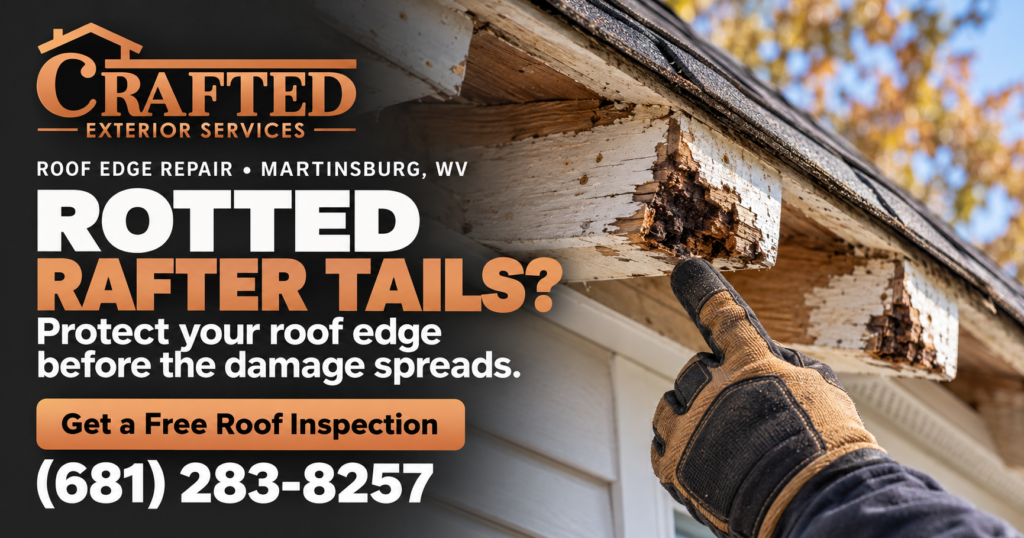
Yes, you can repair rotted rafter tails without removing the roof. Most rafter tail repairs are done from the outside at the eave: the fascia and soffit come off, the rotted end of the rafter is cut back to sound wood, and a new piece of lumber is fastened alongside it or spliced in its place. Which method is right depends on how far the rot has spread, and that is what this guide helps you figure out.
It comes from the team at Crafted Exterior Services, a Martinsburg roofing contractor that sees rotted rafter ends on older homes across Berkeley County, usually during roof repairs and replacements.
What Is a Rafter Tail?
A rafter tail is the end of a roof rafter that extends past the outside wall to form the overhang, or eave. On many homes the tails are hidden behind a fascia board and soffit. On older homes and Craftsman-style houses they are often left exposed as a decorative detail. Either way, the tail holds up the roof edge, the gutter and the first rows of shingles.
Why Rafter Tails Rot
Rafter tails rot when water keeps reaching wood that never fully dries. The usual causes are:
- Overflowing or leaking gutters that spill water behind the fascia.
- Missing or failed drip edge along the roof edge, which lets rain wick under the first course of shingles.
- Ice dams, which back meltwater up under the shingles at the eave. Martinsburg’s freeze-thaw winters make this a common cause here.
- Peeling paint on exposed tails and fascia, which lets water soak straight into the end grain.
How to Tell How Bad the Rot Is
Push a screwdriver into the wood at several points along the tail. Sound wood resists; rotted wood is soft, crumbles or lets the screwdriver sink in. Check where the tail passes over the wall, too. Rot that has traveled inside the wall line changes the repair, and sagging along the roof edge or a gutter pulling away often means more than one tail is affected.
3 Ways to Repair Rotted Rafter Tails
| Method | When it fits | What’s involved |
| Epoxy consolidant and filler | Shallow surface rot, mostly cosmetic, on exposed decorative tails | Dig out soft wood, harden what remains with a consolidant, rebuild the shape with epoxy filler, prime and paint |
| Sistering | Rot in the outer end of the tail, with sound wood at the wall | Fasten a new board alongside the existing rafter, running back past the wall plate, and cut it to match the old profile |
| Splice or full tail replacement | Rot through most of the overhang | Cut the rotted tail off, install a new tail fastened to the existing rafter inside the attic, and rebuild the fascia and soffit |
How to Sister a Rafter Tail, Step by Step
Sistering is the most common structural repair. This is the sequence carpenters typically follow:
- Support the roof edge. Brace the eave temporarily so the roof doesn’t sag while you work.
- Remove the gutter, fascia and soffit around the damaged tails to see the full extent of the rot.
- Cut back to sound wood. Remove the rotted section with a reciprocating saw, keeping clear of the roof sheathing and nails above.
- Fasten the sister board. Use pressure-treated or naturally rot-resistant lumber of the same depth, run it well back past the wall plate (a common carpenter’s guideline is about twice the length of the overhang), and fasten it with structural screws or through-bolts.
- Rebuild and protect the eave. Replace damaged sheathing, install drip edge, reattach the fascia, soffit and gutter, and prime and paint all new wood, including the cut ends.
If the sheathing above the tails is also rotted, the shingles along the eave usually have to come up to replace it. That is the point where many homeowners schedule the repair together with a roof replacement, when the roof edge is already open.
Do You Need a Permit to Repair Rafter Tails in Berkeley County?
Possibly. Cosmetic patching usually doesn’t need one, but replacing structural framing can. Berkeley County’s building permit fee schedule lists a separate fee for rebuilding a roof with new framing, so check with Berkeley County Building Permits and Inspections at 400 West Stephen Street in Martinsburg before starting structural work. Homes inside Martinsburg city limits go through the City of Martinsburg instead.
Rafter Tails on Martinsburg’s Older Homes
Many of the houses in Martinsburg’s historic neighborhoods, including the Boydville Historic District along South Queen Street, were built around the turn of the twentieth century with deep eaves and wood trim that has been taking weather for more than a hundred years. On these homes, matching the original rafter profile matters as much as the structural fix, so the new tail is cut to the same shape and depth as the old one before it is painted to match.
When to Call a Professional
Call a roofer or carpenter if more than one or two tails are soft, if the rot reaches the wall line, if the roof edge is sagging, or if the sheathing above is damaged. Those repairs involve the roof structure and the shingles together. Crafted Exterior Services handles roof repair in Martinsburg, including the rotted wood we find at the eave, and a roof inspection will show how far the damage goes before anything is cut.
Not sure whether you need a repair or a new roof? Read our guide on roof repair vs. replacement, or contact our team for a free inspection and written estimate.
Crafted Exterior Services
Address: 85 Lynnhaven Dr, Suite E, Martinsburg, WV 25404
Phone Number: (681) 283-8257
Google Maps: Find Us Here
Business Hours: Monday to Friday, 8:00 AM to 5:00 PM. Saturday and Sunday: Closed
Frequently Asked Questions
Can you replace rafter tails without removing the roof?
Yes. Most rafter tail repairs are done from the eave by removing the gutter, fascia and soffit, cutting back the rotted wood and sistering or splicing in new lumber. Shingles only come off if the roof sheathing above the tails is also rotted.
What is sistering a rafter tail?
Sistering means fastening a new board alongside the existing rafter so the two work together. The new board runs from the eave back past the wall plate and is fastened with structural screws or bolts.
How do you fix a rotted rafter end?
Cut the rotted section back to sound wood, then either sister a new board alongside the rafter or splice in a new tail. For shallow surface rot on decorative exposed tails, an epoxy consolidant and filler can rebuild the wood.
What causes rafter tails to rot?
Water that keeps reaching the wood: overflowing gutters, missing drip edge, ice dams at the eave, and peeling paint on exposed tails are the most common causes.
Is a rotted rafter tail an emergency?
One soft tail is not an emergency, but it should be repaired before the rot spreads into the wall or the sheathing. A sagging roof edge or a gutter pulling away from the house needs attention right away.
Should rafter tails be repaired during a roof replacement?
It is the best time. The roof edge is already open, so damaged tails, sheathing and fascia can be repaired before the new drip edge and shingles go on.