

A roof is one of the largest investments a homeowner makes, and it takes the brunt of everything the Eastern Panhandle throws at it: humid summers, freeze-thaw winters, spring hailstorms, and heavy autumn leaf drop. The good news is that most roof failures do not happen overnight. They build slowly, through small maintenance gaps that go unnoticed until a leak, a missing shingle, or a soft attic ceiling forces the issue.
This guide walks through every roofing tip and maintenance task a Martinsburg, West Virginia homeowner needs, organized by season, backed by industry guidance, and written by the local team at Crafted Exterior Services. Whether you are a first-time homeowner or you have owned your roof for twenty years, use this as your reference for keeping it healthy for its full lifespan.
Why Roofing Tips & Maintenance Matter More in Martinsburg, WV
Martinsburg sits in a climate zone that is genuinely hard on roofing systems. Summers bring high humidity and intense UV exposure that accelerates shingle aging. Winters bring repeated freeze-thaw cycles, wet snow, and the kind of temperature swings that create ice dams along the eaves. Add in spring thunderstorms and fall leaf debris, and a West Virginia roof is working overtime year-round.
The numbers back this up. Climate data for Martinsburg shows the area sees roughly 21 to 26 inches of snow in a typical year, with January lows averaging near 23°F and July highs reaching the upper 80s, a swing of more than 60 degrees that repeatedly expands and contracts roofing materials. That kind of thermal cycling is exactly what loosens fasteners, cracks sealant, and shortens the service life of an unmaintained roof.
A well-maintained asphalt shingle roof is designed to last twenty to thirty years, but that number assumes consistent upkeep. Skip a few seasons of gutter cleaning or ignore a small flashing leak, and that lifespan can shrink dramatically. Consistent residential roofing maintenance is the single biggest factor separating a roof that reaches year twenty-five from one that needs replacement at year fifteen.
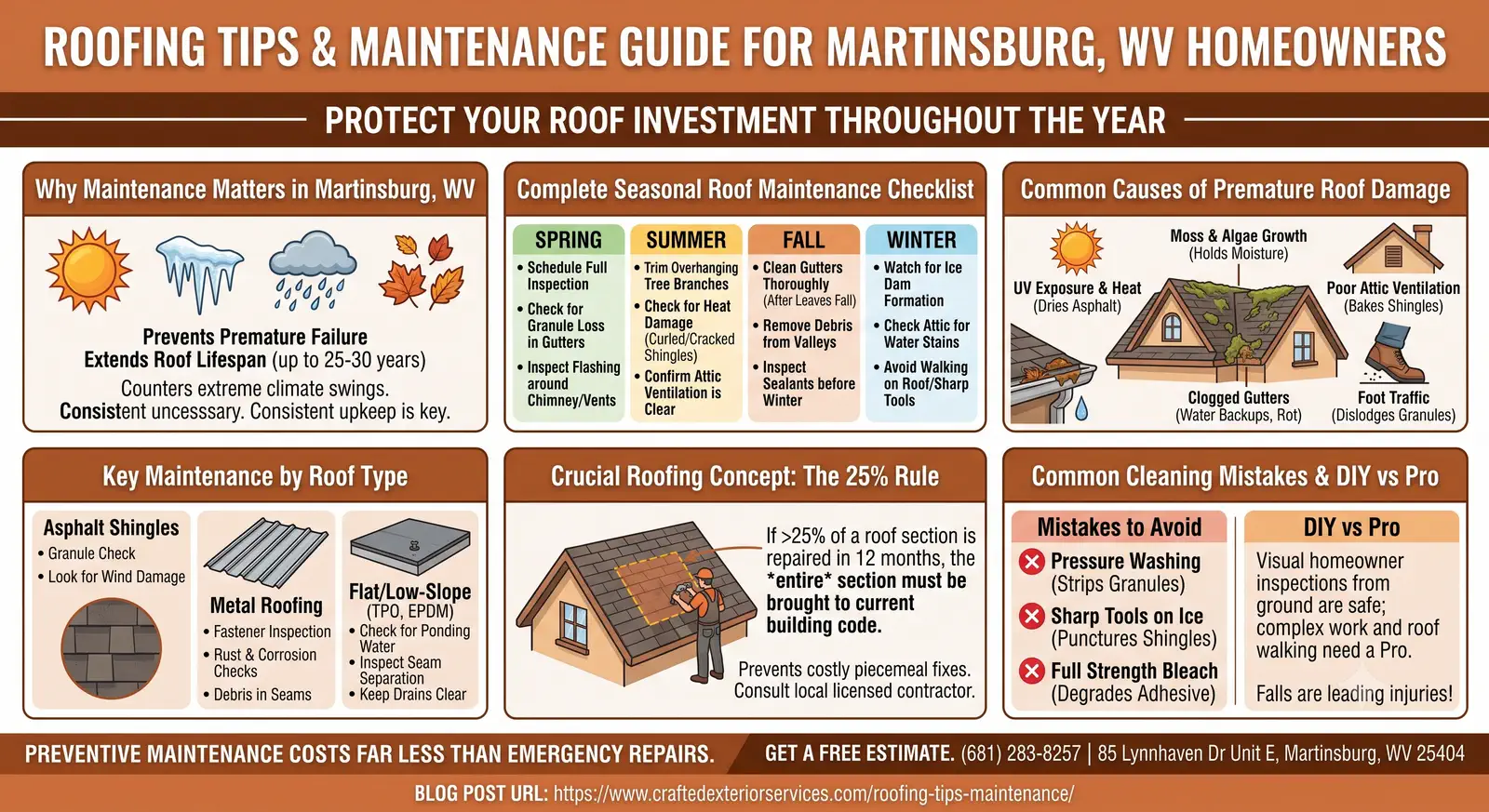
The Complete Seasonal Roof Maintenance Checklist
Rather than a generic list of chores, the tasks below are organized by season, because timing is what actually protects a roof. Doing the right task at the wrong time of year (like cleaning gutters before the last leaves fall) wastes effort. Here is what to prioritize throughout the year.
Spring Roof Maintenance Tasks
- Schedule a full roof inspection to assess any damage from winter snow, ice, and wind.
- Check for granule loss in gutters and downspouts, a sign of accelerated shingle wear.
- Inspect flashing around chimneys, vent pipes, and skylights for cracks or rust after months of freeze-thaw movement.
- Look for signs of moss or algae that thrived under winter moisture and shade.
- Confirm attic ventilation is clear and functioning before summer heat sets in.
Summer Roof Maintenance Tasks
- Trim overhanging tree branches before they scratch shingles or drop debris in fall.
- Check for heat-related damage such as curling, cracking, or blistering shingles.
- Clean gutters of any early debris and verify downspouts direct water away from the foundation.
- Inspect the attic for adequate insulation and airflow, which reduces heat buildup that ages shingles faster.
Fall Roof Maintenance Tasks
- Clean gutters thoroughly after leaves have finished dropping, ideally in late October or November for this region.
- Remove any built-up debris, moss, or leaf litter from valleys and low-slope areas.
- Have flashing, sealant, and vent boots inspected before winter weather arrives.
- Check attic insulation and air sealing, since heat loss through the roof deck is the leading cause of ice dams.
Winter Roof Maintenance Tasks
- Watch for ice dam formation along the eaves after snow and freeze-thaw cycles.
- Remove excess snow load with a roof rake from the ground when safe to do so.
- Check the attic after storms for water stains, which indicate a developing leak.
- Avoid walking on the roof or using sharp tools to chip away ice; call a professional instead.
For homeowners who want the full-year picture in one place, this table summarizes every seasonal roofing task by priority level, so you can plan ahead instead of scrambling when a season changes.
| Season | Key Tasks | Priority |
| Spring | Full roof inspection, flashing check, moss/algae check | High |
| Summer | Tree trimming, heat damage check, attic airflow check | Medium |
| Fall | Deep gutter cleaning, sealant/vent boot inspection, attic air sealing | High |
| Winter | Ice dam monitoring, snow load removal, attic leak checks | High |
How Often Should You Inspect Your Roof?
According to the National Roofing Contractors Association, homeowner-level roof maintenance should be limited to visual inspections during the spring and fall, paired with regular gutter cleaning, while more involved work is best left to a trained professional. Most roofing manufacturers and contractors echo this guidance: two inspections per year, plus an additional check after any major storm, is the standard that keeps small problems from becoming expensive ones.
For Martinsburg homeowners, that means scheduling a professional roof inspection once in early spring to catch winter damage, and once in fall to prepare for the next freeze-thaw season. If your roof is older than fifteen years, twice-yearly inspections become even more important, since aging materials are more vulnerable to sudden failure.
Roofing Material Lifespan Comparison
Maintenance needs differ by roofing material, and so does expected lifespan. Here is how the most common roof types in Martinsburg compare when properly maintained.
| Roofing Material | Typical Lifespan (Properly Maintained) | Primary Maintenance Focus |
| Asphalt Shingle | 20 to 30 years | Gutter cleaning, moss/algae removal, ventilation |
| Metal (Standing Seam) | 40 to 70 years | Fastener checks, rust prevention, coating upkeep |
| Flat/Low-Slope (TPO, EPDM) | 20 to 30 years | Ponding water checks, seam and drain inspection |
What Ruins Asphalt Shingles? Top Causes of Premature Roof Damage
Asphalt shingles are built to withstand decades of weather, but a handful of preventable issues consistently cut roofs short. Understanding these causes is the first step in avoiding them.
- UV exposure and heat: Constant sun exposure dries out asphalt over time, leading to cracking and granule loss.
- Moss and algae growth: Moss holds moisture against the shingle surface, lifting edges and trapping water underneath.
- Poor attic ventilation: Trapped heat and humidity bake shingles from underneath and shorten their service life.
- Foot traffic: Walking on a roof unnecessarily can dislodge protective granules and crack shingle tabs.
- Clogged gutters: Standing water backs up under shingles at the eaves, leading to rot and mold.
- Ice dams: Refrozen meltwater forces its way beneath shingles, one of the most damaging winter events a roof can experience.
If you notice several of these issues at once, it may be time for a closer look from a residential roofing specialist rather than continuing with DIY fixes.
Maintenance Tips for Metal, Flat, and Low-Slope Roofs
Not every roof in the Martinsburg area is asphalt shingle. Many homes use durable metal roofing, and additions, porches, and low-slope sections often use flat roofing membranes. Each roof type has its own maintenance priorities.
Metal Roof Maintenance
A well-maintained metal roof, including standing seam metal roofing, can last 40 to 70 years, far outlasting standard asphalt shingles. That lifespan depends on a few recurring checks:
- Fastener inspection: Screws and clips can back out over time as metal panels expand and contract with temperature swings.
- Rust and corrosion checks: Pay close attention to cut edges, exposed fasteners, and any point where dissimilar metals touch.
- Coating condition: Chalking or fading finish should be recoated before bare metal is exposed to the elements.
- Debris in valleys and seams: Leaves and grit trapped along standing seams can hold moisture against the panel and accelerate corrosion.
Flat and Low-Slope Roof Maintenance (TPO, EPDM)
Flat and low-slope membrane systems, including TPO roofing and EPDM roofing, face different failure points than sloped shingles. Ponding water, seam separation, and membrane punctures are the most common issues, and they are easy to miss from the ground.
- Check for standing water 48 hours after rainfall; persistent ponding stresses the membrane and should be evaluated by a professional.
- Inspect seams and flashing around roof penetrations, such as vents, drains, and HVAC units, at least twice a year.
- Keep drains and scuppers clear of debris to prevent overflow and roof deck saturation.
Homes with additions or porches covered by flat sections, and business owners managing commercial roofing, should treat these systems as a separate maintenance category from the rest of the roof. If you are unsure which category your roof falls into, our roof inspections team can identify what you have and what it needs.
What Is the 25% Rule for Roofing?
The 25% rule is a building code concept that originated in the International Building Code and International Residential Code and has been adopted, with variations, by many state and local jurisdictions. In general terms, it states that if more than 25% of a roof section is repaired, replaced, or recovered within a 12-month period, the entire roof section must be brought up to current building code rather than patched piecemeal.
In practice, this matters most after storm damage. A homeowner might assume a few damaged shingle sections can simply be patched, but if the affected area crosses that 25% threshold, code compliance (and often insurance policy terms) may require a full roof replacement of that section instead of a spot roof repair. Because code adoption varies by county and municipality, Martinsburg homeowners dealing with significant damage should confirm current requirements with a licensed local contractor before assuming a repair will be code-compliant.
Common Roof Cleaning Mistakes to Avoid
Cleaning a roof sounds simple, but a surprising number of well-intentioned homeowners cause damage while trying to maintain their roof. Watch out for these common mistakes.
- Pressure washing shingles: High-pressure water strips protective granules and can force water under the shingle layer.
- Using bleach at full strength: Undiluted bleach can degrade shingle adhesive and harm surrounding landscaping.
- Removing ice with picks or shovels: Sharp tools frequently puncture shingles and flashing while trying to break up ice dams.
- Skipping fall protection: Most roof-related injuries happen during routine cleaning, not major repairs.
- Cleaning at the wrong time of year: Cleaning gutters before all the leaves have dropped means doing the job twice.
If any of this sounds like more risk than it is worth, that is because it usually is. Our roof inspection team handles cleaning and assessment safely, with the right equipment and training for steep-slope work.
Ice Dams, Flashing, and Ventilation: Preventing Winter’s Costliest Roof Damage
Ice dams are consistently one of the most expensive winter roofing problems in cold-climate regions like the Eastern Panhandle. They form when heat escaping from the living space warms the roof deck, melting snow that then refreezes at the colder eaves. Once that ice dam forms, meltwater has nowhere to go but backward, under the shingles and into the home.
NRCA guidance is direct on this point: do not use ice picks, shovels, or any sharp tool to break up ice dams, since these tools frequently damage the roofing material and flashing underneath. Hosing down a roof or using a hot air gun is also discouraged, as neither reliably fixes the underlying problem and both carry their own risks. The more effective long-term fix is proper attic insulation and balanced ventilation, which keeps the roof deck cold and prevents the melt-refreeze cycle from starting in the first place.
If ice dams have been a recurring issue on your home, it is worth having a professional evaluate both your gutters and attic ventilation system together, since the two are closely connected.
DIY vs. Professional Roof Maintenance: When to Call an Expert
Some roof maintenance is safe and reasonable for a homeowner to handle: clearing debris visible from the ground, checking gutters with a stable ladder, and performing a visual inspection with binoculars after a storm. Anything that requires walking on the roof surface, working near the roof edge, or diagnosing a leak’s source should go to a trained professional.
Falls are the leading cause of roofing-related injuries, and many manufacturer warranties require documented professional maintenance to stay valid. If you notice a leak, missing shingles after a storm, or signs of sagging, contact our emergency roof repair team right away rather than attempting a temporary fix yourself.
How Much Does Roof Maintenance Cost in Martinsburg, WV?
Roof maintenance costs vary depending on roof size, pitch, material, and the scope of work needed, but homeowners in the Martinsburg area can generally expect the following rough ranges:
- Professional roof inspection: often free to a few hundred dollars, depending on roof complexity and whether repairs follow.
- Gutter cleaning: typically a modest cost per visit, less expensive than repairing water damage caused by neglect.
- Minor repairs (flashing, small leaks, shingle replacement): moderate cost, and far cheaper than the interior damage a delayed repair can cause.
- Storm damage assessment: often covered in part by homeowner’s insurance after a qualifying weather event.
The most cost-effective roof maintenance strategy is prevention. A seasonal checklist and an annual professional inspection cost far less than the emergency repairs, or full replacement, that neglect eventually causes. Contact us for a free, no-obligation estimate tailored to your roof.
Does Roof Maintenance Affect Your Homeowners Insurance?
Yes, and many homeowners do not realize this until they file a claim. Insurers generally distinguish between sudden, covered damage (a storm, a fallen tree limb) and gradual damage caused by neglect, which is typically excluded from coverage. If an adjuster determines that a leak developed over time due to a lack of maintenance, such as clogged gutters or a long-ignored flashing issue, the claim can be reduced or denied entirely.
Documentation matters here. Keeping dated photos, inspection reports, and receipts from routine roof inspections gives you evidence that damage was sudden and covered, not the result of deferred maintenance. This documentation also matters if a claim triggers the 25% rule discussed above, since insurers rely on the same repaired-area calculations when deciding whether to cover a full section replacement. If you are filing a claim after a storm, our storm damage roofing team can help document damage properly and work through the claims process.
Warning Signs You Need Roof Repair or Replacement
Even with diligent maintenance, every roof eventually shows signs that repair is no longer enough. Watch for these warning signs:
- Multiple missing, curling, or cracked shingles across more than one section of the roof
- Granules collecting heavily in gutters, indicating advanced shingle wear
- Daylight visible through the attic roof boards
- Sagging areas anywhere on the roofline
- Recurring leaks in the same location despite prior repairs
- Storm damage covering a significant portion of a single roof section (see the 25% rule above)
If any of these apply to your home, our detailed guide, How to Tell If Your Roof Needs Repair or Full Replacement, walks through the decision in more depth. For storm-related damage specifically, our storm damage roofing team can help you navigate the insurance process as well.
Trust Crafted Exterior Services for Roof Maintenance in Martinsburg & Across West Virginia
Crafted Exterior Services has helped homeowners throughout Martinsburg and the surrounding Eastern Panhandle protect their roofs for the long haul. From routine seasonal roof inspections to full roof replacement, our local team understands exactly how West Virginia weather affects roofing systems because we see it firsthand every season. Read what your neighbors have to say in our customer testimonials, browse recent work in our project gallery, or learn more about our team.
Ready to schedule your seasonal roof inspection or get a free estimate? Contact our team today and let us help you protect your home for years to come.
Crafted Exterior Services
Address: 85 Lynnhaven Dr Unit E, Martinsburg, WV 25404, United States
Phone Number: (681) 283-8257
Google Maps: Find Us Here
Business Hours:
Monday: 8:00 AM To 5:00 PM
Tuesday: 8:00 AM To 5:00 PM
Wednesday: 8:00 AM To 5:00 PM
Thursday: 8:00 AM To 5:00 PM
Friday: 8:00 AM To 5:00 PM
Saturday: Closed
Sunday: Closed
Frequently Asked Questions About Roofing Tips & Maintenance
What maintenance should be done on a roof?
Regular roof maintenance includes gutter cleaning, removing moss and algae, trimming overhanging branches, inspecting flashing around chimneys and vents, checking attic ventilation and insulation, and scheduling a professional inspection at least twice a year, in spring and fall.
How often should you inspect your roof in West Virginia?
West Virginia’s freeze-thaw winters and humid summers make biannual inspections essential. Check your roof once in spring to assess winter damage and once in fall to prepare for the next freeze-thaw season. Roofs older than 15 years should be inspected more frequently.
What is the 25% rule for roofing?
The 25% rule is a building code concept stating that if more than 25% of a roof section is repaired, replaced, or recovered within a 12-month period, the entire section must be brought up to current code. Rules vary by county and municipality, so West Virginia homeowners should confirm requirements with a local licensed contractor.
What ruins asphalt shingles in Martinsburg and across West Virginia?
Common causes of premature shingle damage include prolonged UV exposure, moss and algae growth, poor attic ventilation, excessive foot traffic, clogged gutters, and ice dams. Each of these accelerates granule loss, cracking, and curling.
How do you prevent ice dams on a roof?
Ice dams form when heat escaping the attic melts snow that then refreezes at the eaves. Prevention starts with proper attic insulation and balanced ventilation to keep the roof deck cold. Avoid removing ice with picks or shovels, since sharp tools often damage shingles and flashing.
What are common roof cleaning mistakes?
Frequent mistakes include pressure washing shingles (which strips granules), using full-strength bleach, removing ice with sharp tools, skipping fall protection while on the roof, and cleaning gutters before all leaves have dropped.
How long does a roof last in West Virginia’s climate?
Most asphalt shingle roofs are rated for 20 to 30 years, but West Virginia’s freeze-thaw cycles, humidity, and storm activity can shorten that lifespan without consistent maintenance. Roofs with regular inspections and prompt repairs tend to reach the higher end of that range.
Can I do roof maintenance myself, or should I hire a professional?
Ground-level tasks like clearing visible debris and checking gutters from a stable ladder are generally safe for homeowners. Anything requiring walking on the roof, working near the edge, or diagnosing a leak’s source should be handled by a licensed roofing professional to avoid injury and protect manufacturer warranties.
How often should I clean my gutters?
Most Martinsburg homes need gutter cleaning at least twice a year: once in late spring and once in late fall after leaves have finished dropping. Homes with heavy tree coverage may need a mid-summer cleaning as well.
Does Crafted Exterior Services offer emergency roof repair in Martinsburg & across West Virginia?
Yes. Our emergency roof repair team responds quickly to storm damage, active leaks, and other urgent roofing issues throughout the Martinsburg & across West Virginia area. For more common questions, visit our full FAQ page.